
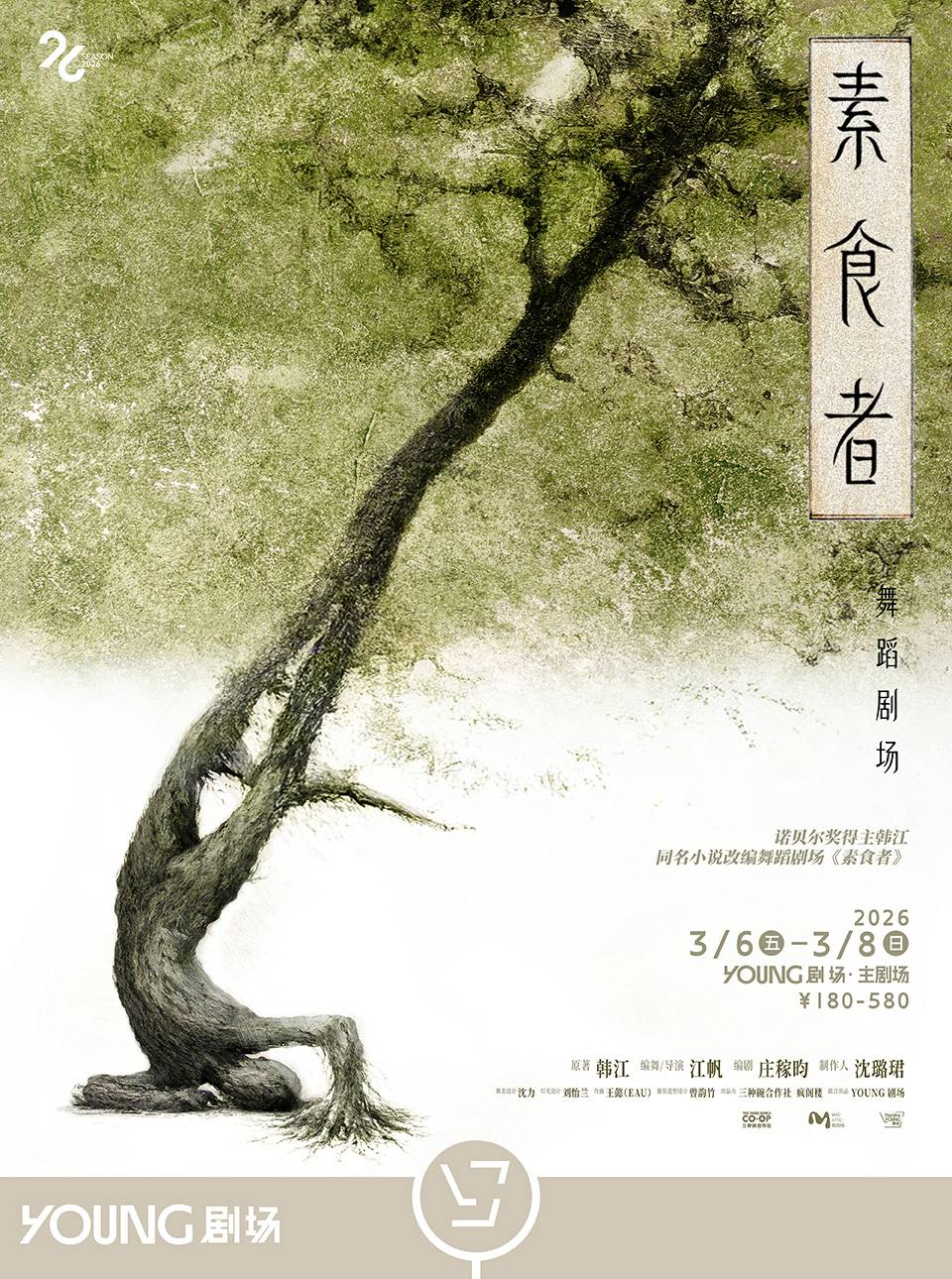
Dance Theatre The Vegetarian
Venue:
Theatre YOUNG
NO.1155, Kongjiang Rd Yangpu Shanghai
Date:
3/6/2026 - 3/8/2026
Dance Theatre The Vegetarian
3/6/2026 - 3/8/2026
Theatre YOUNG
NO.1155, Kongjiang Rd Yangpu Shanghai
¥180 - ¥646
Event details
👉 Exchanging paper ticket at the venue with the ticket code which you received via text message starting with [YOUNG剧场]
👉 Children under 1.2m are not allowed to enter
👉 Children over 1.2m will be admitted by full tickets
👉 No cancellation
👉 Children under 1.2m are not allowed to enter
👉 Children over 1.2m will be admitted by full tickets
👉 No cancellation
A Masterpiece by 2024 Nobel Prize Laureate Han Kang
Adapted into a Dance Theatre for the First Time in Asia
Dance theatre production "The Vegetarian" is officially announced!
Adapted into a Dance Theatre for the First Time in Asia
Dance theatre production "The Vegetarian" is officially announced!
March 6-8, 2026 Premiere @ Shanghai YOUNG Theatre
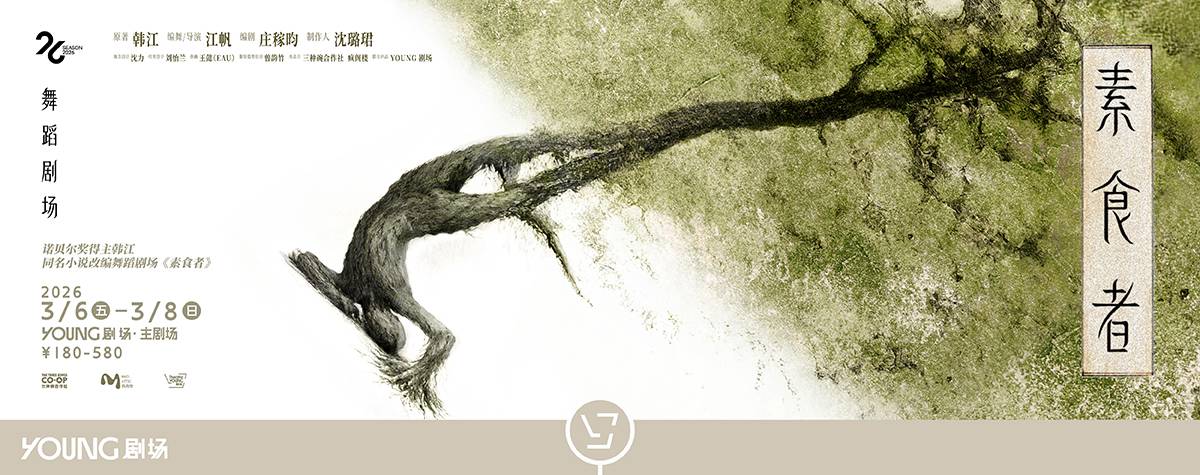
A phenomenal feminist masterpiece that has swept the globe
From text to theatre, interpreting a contemporary allegory about free choice and social norms
A Sharp and Incisive Work that cuts through Feminism, Patriarchy, and Violence
From text to theatre, interpreting a contemporary allegory about free choice and social norms
A Sharp and Incisive Work that cuts through Feminism, Patriarchy, and Violence
"If you don't eat meat now, the people of this world will eat you."
A popular novel that topped the charts of Korean women's literature
Making its debut on the Chinese stage, subverting expectations with a tense and poetic dance theatre production
A popular novel that topped the charts of Korean women's literature
Making its debut on the Chinese stage, subverting expectations with a tense and poetic dance theatre production
Creative inceptions approved by Han Kang herself, conveying the story's core through performers' movement
"When I write, I often think about these questions: To what extent can human violence reach?How do we define rationality and madness? To what extent can we understand others?I hope 'The Vegetarian' can answer these questions for me."
— HAN Kang
— HAN Kang
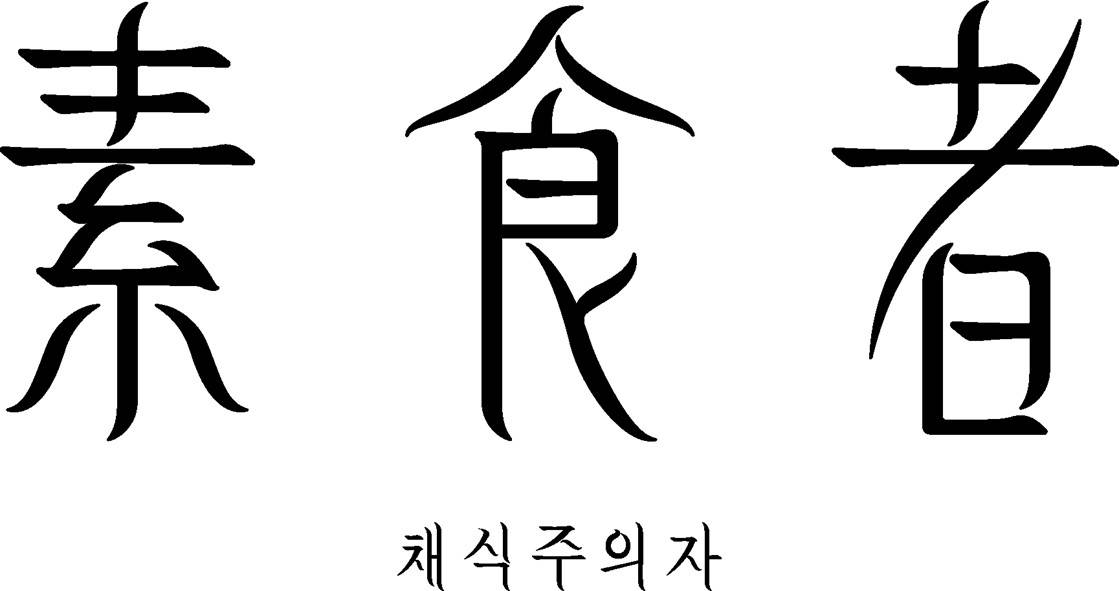
Synopsis
The dance theatre "The Vegetarian" is adapted from the novel by Korean author Han Kang (winner of the 2024 Nobel Prize in Literature). The original work uses the physical and mental transformation of the female protagonist, Yeong-hye, as a clue, telling the story of how she stops eating meat after a dream, and gradually refuses to be interpreted, refuses to eat, and moves towards a state of existence almost like a plant.
The dance theatre "The Vegetarian" is adapted from the novel by Korean author Han Kang (winner of the 2024 Nobel Prize in Literature). The original work uses the physical and mental transformation of the female protagonist, Yeong-hye, as a clue, telling the story of how she stops eating meat after a dream, and gradually refuses to be interpreted, refuses to eat, and moves towards a state of existence almost like a plant.
Director's notes
Facing Han Kang's "The Vegetarian", I've always felt a sense of awe and pressure. It's like a mirror, reflecting the dark side of all of us within the "normal" order. Our adaptation doesn't aim to realistically recreate the novel's content, but rather focuses on presenting the subtle and chilling process of violence's insidious erosion, transforming this invisible violence into theatrical energy that can be perceived by the audience.
Facing Han Kang's "The Vegetarian", I've always felt a sense of awe and pressure. It's like a mirror, reflecting the dark side of all of us within the "normal" order. Our adaptation doesn't aim to realistically recreate the novel's content, but rather focuses on presenting the subtle and chilling process of violence's insidious erosion, transforming this invisible violence into theatrical energy that can be perceived by the audience.
I want to express once again the greatness of Han Kang; her work constantly makes me ponder: Young-hye's refusal, beginning with vegetarianism, ultimately leads to the rejection of the human form. Is this the powerless resistance of the weak, or the ultimate awakening of the wise? Her inner world collapses, but does that almost plant-like state of existence build something new upon the ruins? These questions haunt me day and night.
I look forward to breathing this pressure-laden air together with the audience in the theater. We may not be able to provide the "standard" answers you seek, but we hope to share a tremor of "spiritual boundaries" through this shared experience, thus gaining a brief, unfamiliar glimpse into the "normalcy" upon which we depend for our existence.
—Choreographer/Director JIANG Fan
Playwright's notes
The first time I read *The Vegetarian*, my mind and body went on a journey with Yeong-hye, constantly pushing the limits. Perhaps many readers have also wondered: Was this Yeong-hye's only option? How will In-hye continue her life?
This is the power of the novel's narrative ethics—it doesn't explain Yeong-hye's choices, but instead pushes us towards a more fundamental question: How do we coexist with lives that refuse to be explained? How are their voices obscured, suppressed, and ultimately silenced within family, society, and intimate relationships? This sense of suspension, suffocation, and unresolvable frustration experienced during reading is precisely the starting point for our theatrical adaptation of the text.
Theater is a method of discovery, and the body is the site where both power and trauma simultaneously occur. When language fails, the body remains present, continuously asking questions. Yeong-hye's body can no longer bear the burden of existence as a human being: she refuses to eat, refuses to function, refuses to be "fixed," and thus encounters even more direct violence. In-hye's body also struggles to maintain "normal" integrity, constantly depleting itself through caregiving and maintenance, becoming the hidden cost of the community's functioning. Our work will present these bodies in their states of exhaustion, struggle, and failure; capture the moments of their mutual searching and brief alliances; and transform the cycle of violence constituted by infantilization, domestication, and sexualization into a tangible sensory experience for the audience.
This is what theater can do: create a perceived re-presence for those whose voices have been silenced.
—Playwright ZHUANG Jiayun
—Playwright ZHUANG Jiayun
Adapted from HAN Kang's novel The Vegetarian
Choreographer/Director JIANG Fan
Playwright ZHUANG Jiayun
Producer SHEN Lujun
Stage Design SHEN Li
Light Design LIU Yilan
Composer WANG Yi (EAU)
Costume Design ZENG Yunzhu
Choreographer/Director JIANG Fan
Playwright ZHUANG Jiayun
Producer SHEN Lujun
Stage Design SHEN Li
Light Design LIU Yilan
Composer WANG Yi (EAU)
Costume Design ZENG Yunzhu
Dancer
CHEN Shuchang
DING Youwei
LIAO Jinglin
WANG Can
XU Zhixiang
XUE Wendan
YU Guo
CHEN Shuchang
DING Youwei
LIAO Jinglin
WANG Can
XU Zhixiang
XUE Wendan
YU Guo
Notice
Date: Friday, 6th Mar. - Sunday, 8th Mar.
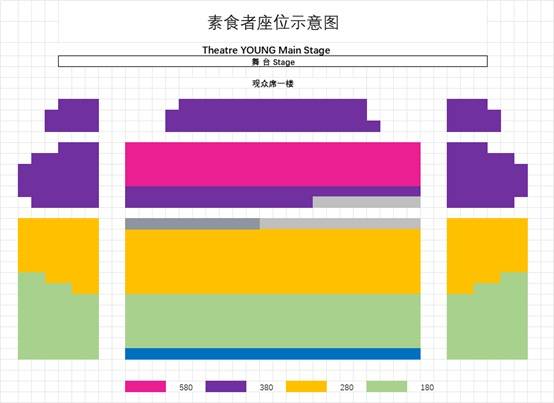
Price: 180/280/380/580
Language: Performed in Chinese with English subtitles
Duration: 70 mins (no intermission)
Ticket Collection Method
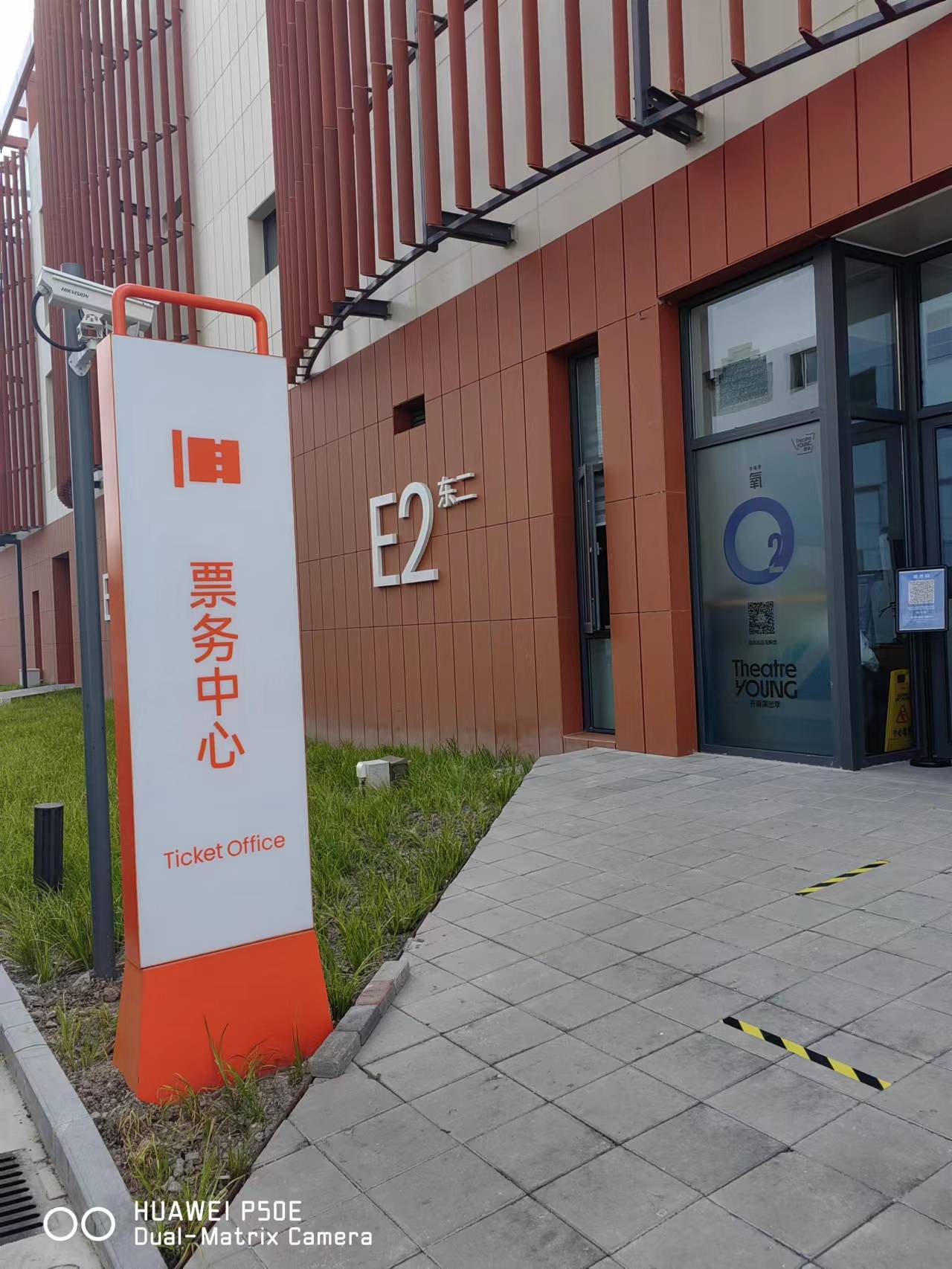
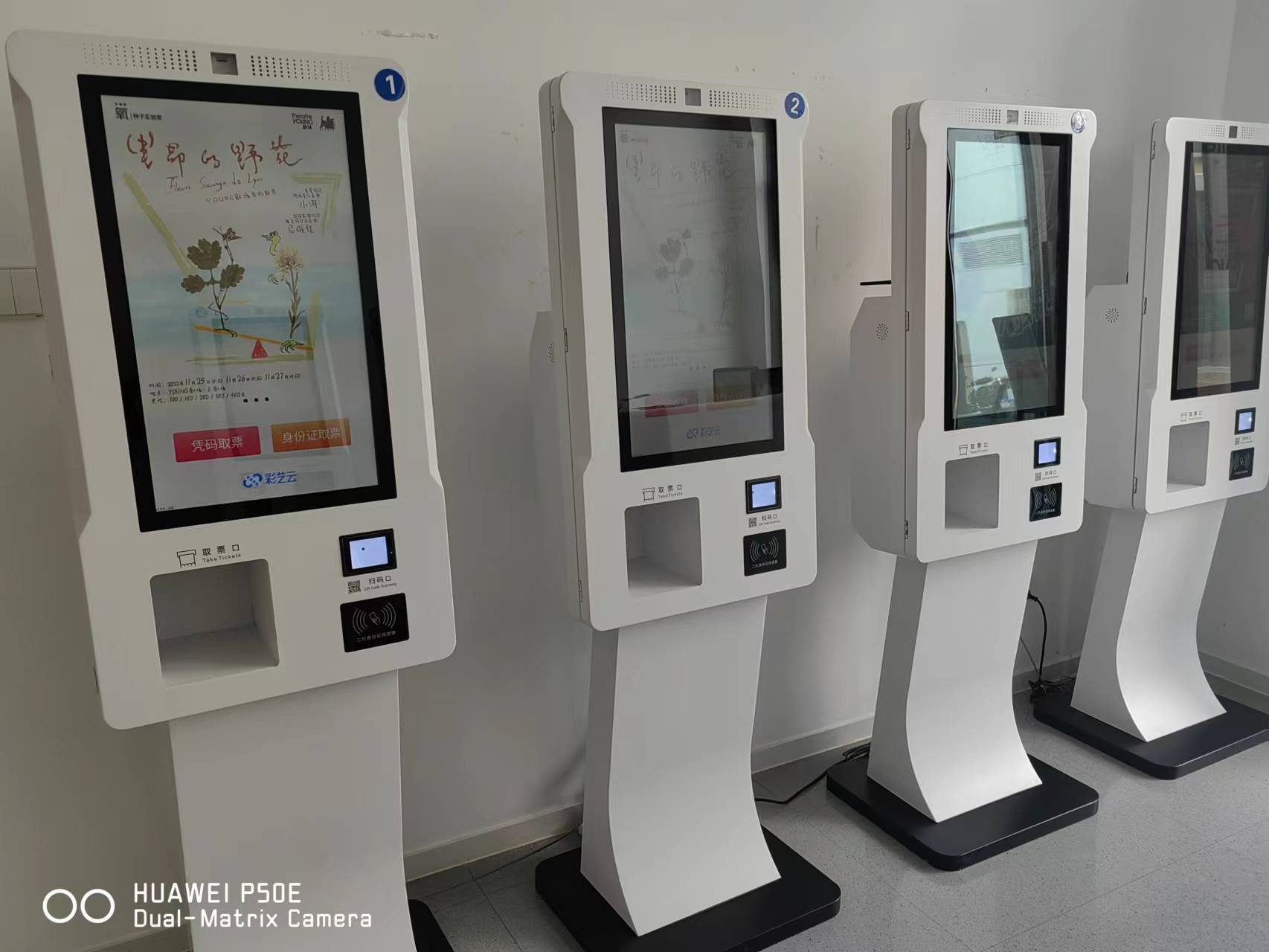
Please take your tickets at the Ticket Center of the YOUNG Theater (E2 gate of the theater) before the show, enter the ticket collection code on the self-service ticket machine with the QR code in the SMS which you received, and then enter the theater after exchanging the paper ticket.
Please take your tickets at the Ticket Center of the YOUNG Theater (E2 gate of the theater) before the show, enter the ticket collection code on the self-service ticket machine with the QR code in the SMS which you received, and then enter the theater after exchanging the paper ticket.
working hours of ticket office: 10:00 - 20:00

Follow our WeChat for event news, deals, gossip and more!
Book Now
Dance Theatre The Vegetarian
Venue:
Theatre YOUNG
NO.1155, Kongjiang Rd Yangpu Shanghai
Date:
3/6/2026 - 3/8/2026
© 247tickets 2020 沪ICP备19024898号-2

 Add us on WeChat to speak to our friendly customer service team! ID: love247tickets